April 26, 1986, 1:23 in the morning.
Reactor No. 4, Chornobyl Nuclear Power Plant, northern Ukraine.
That night the crew was running a safety test.
The question: if the plant lost power, could the spinning turbine keep the cooling pumps running for about a minute until the backup generators kicked in?
The test had been delayed most of the day, so it was handed to the night shift.
- To run the test, they made some choices:
- They switched off the emergency core cooling system, the backup way to cool the reactor if things went wrong.
- When power dropped too low, they pulled out control rods to bring it back up.
- By the time the test began, there were far fewer rods in the core than the safety rules required.
Control rods are what keep a reactor a power plant instead of a bomb.
- They don’t stop the reaction from existing.
- They absorb the excess energy so the reaction stays useful.
- Pull enough of them out and every bit of heat starts producing more heat.
That reactor had a dangerous design flaw:
- As the water boiled into steam, the reaction sped up.
- A faster reaction made more steam.
- More steam made the reaction faster still.
- In other words, the reaction fed itself.
At 1:23:40, an operator hit the emergency shutdown button.
Every remaining rod started moving into the core.
- But they moved too slowly, about 18 to 20 seconds to go all the way in.
- Because of how the rods were built, their first few seconds of movement actually made the surge worse.
- The core overheated, the channels warped, and the rods jammed partway down.
No rods to stop it. No backup system to cool it. Two explosions followed.
The disaster happened because nothing was left to control it.
- Marriage can be a lot like that.
- Two people, a lot of energy, and plenty of heat.
- Conflict will happen. That isn’t the failure.
- The question is what happens when it starts to run hot.
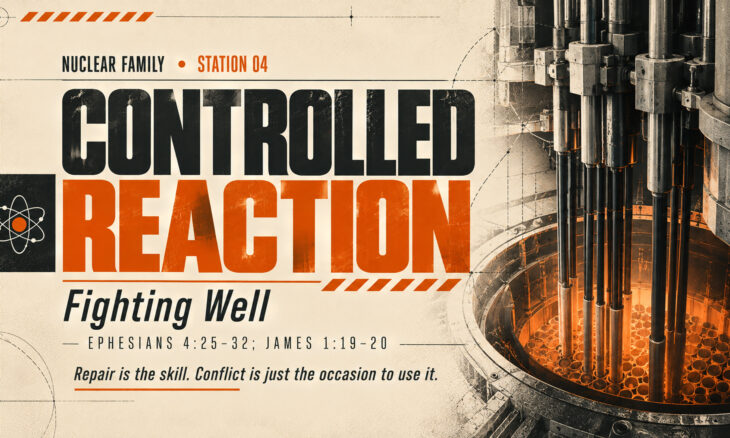
Today we will learn how to handle conflict without allowing it to destroy relationships. And what will control it when things start to get out of control?
I. REACTION IS NOT SIN
Ephesians 4:26
Be angry and do not sin; do not let the sun go down on your anger,
Paul writes it as a command – He does not say avoid anger. He says be angry, and then puts a fence around it.
- Paul is quoting Psalm 4:4out of the Greek Old Testament, and the Hebrew underneath is closer to tremble or be agitated.
- Paul’s imperative is permission rather than instruction — if you are angry, do not sin.
- Anger is not automatically disqualifying.
- However, what you do with it might be.
Anger tells you something matters.
Sometimes anger says:
- I feel hurt.
- I feel ignored.
- I feel frightened.
- I feel disrespected.
- Something important to me feels threatened.
The emotion itself can be information.
- But information is not instruction.
- Just because anger tells you something is wrong doesn’t mean anger gets to tell you what to do next.
That’s where the control rods come in.
James gives us three:
James 1:19–20
Know this, my beloved brothers: let every person be quick to hear, slow to speak, slow to anger; 20 for the anger of man does not produce the righteousness of God.
Quick to hear. Slow to speak. Slow to anger — and the word for slow means deliberate, a thing that moves on purpose.
Then James gives the reason – the anger of man does not produce the righteousness of God.
A: Quick to hear.
Before I explain myself, understand you.
Most of us listen during conflict for just long enough to find the sentence we want to correct.
While the other person is still talking, we’re already preparing the rebuttal:
- “That’s not what happened.”
“That’s not what I meant.”
“Well, you did the same thing last week.”
But James says the first move is not explanation. It is understanding.
So before you defend yourself, try to say back what you heard:
“What I’m hearing you say is that when I did that, you felt like I wasn’t considering you. Is that what you mean?”
You don’t have to agree with everything they said in order to understand what they said. That’s an important distinction:
Understanding is not surrendering.
You can say:
- “I don’t see it exactly the same way, but I understand why you experienced it that way.”
- That one sentence can change the temperature of a conversation.
The goal isn’t merely to hear their words. It’s to hear what is underneath them.
- Sometimes anger is really hurt.
- Sometimes criticism is really fear.
- Sometimes frustration is really:
- “Do I matter to you?”
So ask questions before making arguments.
- “What hurt you most about that?”
“What did you hear me saying?”
“What do you need me to understand?”
That’s being quick to hear.
B: Slow to speak.
Not every thought deserves immediate release.
One of the great lies of conflict is:
“If I think it, I need to say it right now.” ……. No, you don’t.
There are things you can say in fifteen seconds that take a lifetime to repair.
- When emotions rise, your mouth can become a weapon looking for ammunition.
- And once a sentence leaves your mouth, you don’t get to decide how deeply it cuts.
So before you speak, put your words through a very simple filter:
- Is it true?
- Is it necessary?
- Is this the right time?
- Am I saying this to repair something—or to hurt them back?
That last question may be the most important.
Because sometimes we’re not trying to communicate. We’re trying to make the other person feel what we feel.
- “You hurt me, so I want you to hurt too.”
- That’s when sarcasm appears.
- That’s when old failures get dragged into a new argument.
- That’s when “You always…” and “You never…” come out.
- That’s when we say something we know is especially painful because we know exactly where the soft spots are.
So:
Slow to speak means I refuse to use intimate knowledge as ammunition.
- Your spouse has trusted you with weaknesses, fears, insecurities, family history, and failures.
- Those are not weapons.
- And sometimes the most spiritually mature thing you can say in an argument is:
- “Give me a minute. I don’t want to say this badly.”
That’s wisdom applying the control rods.
C: Slow to anger.
Don’t let emotional energy accelerate faster than wisdom can control it.
James doesn’t say, “Don’t be angry.” He says:
Be slow about getting there.
In other words, learn to recognize when the reaction is beginning to accelerate.
- Maybe you know your signs.
- Your voice gets louder.
- Your heart starts pounding.
- You interrupt more.
- Your jaw tightens.
- You start repeating yourself.
- You stop hearing what the other person is actually saying.
- At some point, you’re no longer having a conversation.
- You’re having a reaction.
That’s when wisdom says:
Slow it down.
Maturity isn’t learning how never to react. Maturity is learning what gets to govern the reaction
When the temperature rises, slow the conversation down rather than turning the volume up.
And that really gives you a very practical James 1:19 conflict plan:
Quick to hear:
“Help me understand what you’re saying.”
Slow to speak:
“I don’t have to say everything I’m thinking.”
Slow to anger:
“If I’m losing control, I can slow this down and come back.”
That’s what control rods do. They don’t deny that energy exists. They keep the energy from becoming destructive.
And that’s what James is giving us here.
Listen faster.
Speak slower.
Escalate slower.
Because the goal is not to win the reaction.
The goal is to protect the relationship while you work through it.
There are times when it is absolutely appropriate to feel anger.
Jesus was dealing with hard-hearted, self-righteous people in Mark 3
Mark 3:5
5 And he looked around at them with anger, grieved at their hardness of heart, and said to the man, “Stretch out your hand.” He stretched it out, and his hand was restored.
He was angry, He did not sin, and the thing holding those two apart was grief.
- His anger had somebody’s good underneath it.
- Mine usually has our own reasons underneath it.
When tension rises, ask:
- Am I trying to understand, or am I loading ammunition?
- Am I trying to solve something, or am I trying to win something?
- Am I speaking to my spouse—or reacting at my spouse?
II. LOSING GROUND
Unresolved Conflict Occupies Space
Ephesians 4:26–27
“Do not let the sun go down on your anger, and give no opportunity to the devil.”
The word translated opportunity or foothold is topos.
It literally refers to a place, a location, a piece of ground.
- Unresolved anger doesn’t simply create a bad mood.
- It gives something destructive a place to stand.
Paul says unresolved anger starts handing out real estate.
At first it may only be a small piece of ground.
- A wound we didn’t discuss.
- An apology we never offered.
- A resentment we decided to keep.
- A conversation we promised to return to but never did.
But give something enough ground and eventually it starts building on it.
The danger of unresolved conflict is accumulation.
- “She always does this.”
- “He never listens.”
- “She doesn’t care.”
- “He only thinks about himself.”
And that is when conflict changes.
Now we are no longer responding to what happened today.
We are responding to a whole history we have collected and organized in our minds.
We stop arguing with the moment and start arguing with the file folder.
- Every old hurt gets pulled out.
- Every previous failure becomes evidence.
- Every current mistake gets interpreted through everything that came before it.
And eventually you can be fighting about a dirty dish, a late text, or a forgotten errand—but the emotional weight in the room has almost nothing to do with that one event.
You are carrying years of accumulated evidence into a five-minute conversation.
That is why Paul gives anger a clock.
“Do not let the sun go down on your anger…”
I Don’t think that means that every disagreement must be completely solved before bedtime.
- Some problems are too complicated for that.
- Some conversations need time.
The issue is whether anger is being allowed to settle in and make itself at home.
There is a difference between:
- “We haven’t solved this yet.”
- “We have stopped trying to repair this.”
What begins as anger can settle into resentment.
- Resentment can harden into bitterness.
- Bitterness can become contempt.
- And once contempt takes hold, we are no longer simply saying: “You hurt me.”
- We begin saying: “This is who you are.”
That is why Paul’s instruction has urgency.
Don’t become comfortable giving anger permanent residence.
Conflict becomes dangerous when temporary anger is allowed to establish a permanent address.
III. THE REPAIR
Winning the Argument Is Not Winning the Marriage
Ephesians 4:29–32
Let no corrupting talk come out of your mouths, but only such as is good for building up, as fits the occasion, that it may give grace to those who hear. 30 And do not grieve the Holy Spirit of God, by whom you were sealed for the day of redemption. 31 Let all bitterness and wrath and anger and clamor and slander be put away from you, along with all malice. 32 Be kind to one another, tenderhearted, forgiving one another, as God in Christ forgave you.
A: Don’t let conflict turn into character
Paul moves from anger to bitterness, wrath, clamor, slander, and malice.
- The warning is that unresolved conflict can stop being about the issue and start shaping the person.
- What begins as anger over something can become bitterness toward someone.
- At that point, we are no longer trying to solve a problem. We are carrying a posture.
Anger is an emotion. Bitterness is anger that has been given a home.
B: Remember who is present in the room
“Do not grieve the Holy Spirit of God…”
Marriage conflict is never just between two people.
- For the Christian, the Holy Spirit is present in the relationship and present in the conversation.
- That means the question is not only: “Am I right?”
- It is also: “Is the way I am handling this pleasing to the Spirit of God?”
So before I speak, retaliate, exaggerate, accuse, or wound, I have to remember:
The Spirit who sealed me is also shaping me.
C: Forgive each other
Paul does not simply tell us what to put away; he tells us what must take its place: kindness, tenderness, and forgiveness.
“Be kind to one another, tenderhearted, forgiving one another, as God in Christ forgave you.”
Here is the control rod.
Healthy couples still misunderstand each other.
- They still say things badly.
- They still become defensive.
- They still occasionally hurt one another.
- The difference is that they learn how to come back and fix things.
That may be one of the most important skills in marriage:
Not learning how never to damage the relationship, but learning how to repair damage when it occurs.
Repair sounds like:
- “I said that badly. Let me try again.”
- “You’re right about that part.”
- “I understand why that hurt you.”
- “I was defensive.”
- “I’m sorry.”
- “Can we start over?”
None of those sentences surrender the entire disagreement.
They protect the relationship while the disagreement is being worked out.
The World Says: Win
The instinct of conflict is to ask:
- Who is right?
- Who started it?
- Who has the better argument?
- Who gets the last word?
And there certainly are times when truth matters and one person genuinely is wrong.
- But you can win an argument and lose something much more valuable.
- You can prove your point while humiliating your spouse.
- You can produce evidence.
- Win the debate.
- Land the perfect line.
- Walk out feeling vindicated.
- And leave the person you love broken behind you.
Jesus offers another way.
“…forgiving one another, as God in Christ forgave you.”
That changes the standard completely.
The standard is no longer: What does my spouse deserve from me?
The standard becomes: What have I received from Christ?
- Patience I didn’t deserve.
- Mercy I didn’t earn.
- Grace before I had everything fixed.
- Forgiveness more than once.
The world says: win the argument.
Jesus says: repair the relationship.
- Not because truth doesn’t matter.
- Not because sin doesn’t matter.
- Not because boundaries don’t matter.
- But because the gospel teaches us that restoration is more important than domination.
CONCLUSION
Go back to Reactor 4.
Chornobyl didn’t fail because of one bad moment at 1:23 a.m.
- It failed because of decisions made hours earlier.
- The rods had been pulled out before anyone needed them.
- The cooling system had been switched off before anyone felt the heat.
The control rods have to be in place before the reaction spikes. (James 1:19–20)
- You don’t decide to be quick to hear in the middle of the shouting.
- You decide it now, in the calm.
- If you’ve already pulled the rods out, you won’t find them when you need them.
Late, half-hearted control can make things worse.
- Those rods did eventually move, but too slowly, and their first effect was a spike.
- Some of our “repairs” work the same way:
• “I’m sorry you feel that way.”
• “Fine. Whatever. You win.” - A brake that arrives grudgingly can add heat instead of taking it away.
Then came the lost ground. (Ephesians 4:27, topos)
- Pripyat, the city next door, was home to about 49,000 people.
- They were evacuated and told to pack for about three days.
- They never went back.
- Nearly forty years later, the exclusion zone covers roughly a thousand square miles that nobody lives in.
- What was meant to be temporary got a permanent address.
- That is what unresolved anger does: it hands over ground you meant to take back later.
But here’s the rest of the story. (Ephesians 4:32)
- After Chornobyl, engineers went back and changed the design.
- They required more rods to stay in the core, made the rods go in faster, and fixed the flaw in how they were built.
- They learned from the damage and built so it wouldn’t happen the same way again.
- That’s repair. You don’t pretend the meltdown didn’t happen. You change what controls the reaction.
Your marriage will produce heat. It’s supposed to. That energy can light and warm a home for decades.
So the question isn’t whether the reaction exists. It’s this:
Are your control rods in place right now, before you need them?