
Money consistently becomes one of the pressure points in marriage.
But most couples aren’t actually fighting about the number on the receipt.
They’re fighting about what the number means.
One spouse sees a purchase and thinks:
- “We can afford it.”
- The other sees the same purchase and thinks: “We’re not safe.”
One grew up in a house:
- where money was always tight.
- The other grew up in a house where spending money was how people celebrated.
One learned:
- Save everything because tomorrow could fall apart.
- The other learned:
- Enjoy it now because tomorrow isn’t guaranteed.
So two people get married, combine their bank accounts—and unknowingly combine their financial histories.
Generally, we’re not fighting about money. We fight about:
- Fear,
- Control,
- Security,
- Priorities,
- Early financial trauma.
And underneath all of that is something even more important.
There are two enormous currencies operating inside a marriage:
Money and trust.
You can lose money and rebuild it…….
But when the way we handle money begins destroying trust, the cost becomes much greater than what disappeared from the checking account.
I. MONEY REVEALS WHAT HAS WEIGHT (Priority)
Jesus said a great deal about money, and it wasn’t because He was interested in our bank accounts.
He knew our spending reveals what actually carries weight in our lives, often more honestly than our words do.
Proverbs 3:9
“ Honor the Lord with your wealth
and with the firstfruits of all your produce;
The Hebrew word translated honor is kabed.
- It carries the idea of weight, heaviness, significance.
- To honor something is to treat it as weighty.
So when Proverbs says: “Honor the LORD with your wealth…”
- It isn’t simply saying, “Give God some money.”
- It is saying: Let God carry the greatest weight in the way you handle money.
That changes the question. Instead of:
“Can we afford this?”
We begin asking:
“Does this reflect what we say matters most?”
Because every household has financial priorities; sometimes they are:
- Comfort.
- Experiences.
- Status.
- Security.
- Children.
- Retirement.
- Generosity.
- Or God.
A: Your spending reveals your priorities.
Jesus makes essentially the same point:
Matthew 6:21
“For where your treasure is, there your heart will be also.”
We often read that backward. We think: My money follows my heart.
- Jesus says your heart begins following your money.
- What you continually fund gains emotional weight.
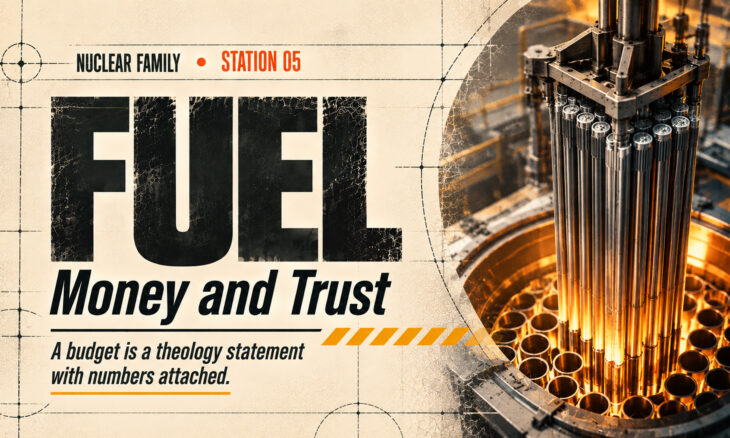
That’s why: A budget is a theology statement with numbers attached.
- Your bank statement may reveal your functional theology more accurately than your doctrinal statement.
B: Marriage requires deciding together what gets the weight.
Before marriage, I could decide what mattered financially. Now there is an us.
So financial discipleship in marriage means asking:
- What kind of household are we trying to build?
- Not just: What kind of lifestyle can we afford?
In a reactor, fuel isn’t burned just to make heat.
- The heat boils water.
- The steam turns turbines.
- The turbines send power to homes across the region.
Heat that goes nowhere isn’t power; it’s a problem.
Money works the same way in a marriage.
- It isn’t meant simply to be consumed.
- It’s meant to drive something beyond itself.
So the question isn’t just: “How much fuel do we have?”
It’s: “What is our fuel powering?”
I have found that A household that never decides what its fuel is for will burn through it anyway; it just won’t have anything to show for it.
II. MONEY EXPOSES WHAT WE FEAR
1 Timothy 6:6–8
But godliness with contentment is great gain, 7 for we brought nothing into the world, and we cannot take anything out of the world. 8 But if we have food and clothing, with these we will be content.
Paul begins talking about money by talking about contentment.
Because financial problems aren’t always mathematical problems.
Sometimes they’re soul problems.
Money has an extraordinary ability to expose what is happening underneath the surface.
A: Some of us use money to feel secure.
- If I can just get enough saved, I’ll finally feel safe.
- Proverbs 18:11says it exactly: a rich man’s wealth is his strong city, and like a high wall — in his imagination. The wall is real money. The safety is imagined.
- Here is the tell. There is never a number. You hit the number and the number moves, because the fear was never about the amount.
- The rich fool in Luke 12was not a crook. He was a good farmer with a storage problem and a plan. God’s verdict was not you stole. It was you fool — this night your soul is required of you.
- In a marriage this one looks responsible, and that is what makes it hard to name. One spouse is saving, and the other is slowly learning that no amount of caution will ever be enough to get a yes.
B: Some use money to feel successful.
- If we can get the house, the truck, the vacation, the clothes — then we’ll have arrived.
- Luke 12:15— one’s life does not consist in the abundance of possessions. Jesus says that on the way into the barn story, which means He is answering the scoreboard before He answers the savings account.
- The trouble with a scoreboard is that it is never only yours. You are always playing against somebody.
- Solomon ran this all the way out in Ecclesiastes 2:4–11— houses, vineyards, pools, silver, singers. Then he looked at every bit of it and called it chasing wind.
- In a marriage this one turns your spouse into a teammate in a game they never agreed to play. And when the score goes down, they feel it as blame.
C: Some use money to feel free.
- Nobody is going to tell me what I can do with my money.
- That sentence sounds like independence, and it is the oldest offer in Scripture. Genesis 3— you will be like God, knowing for yourself.
- Romans 6:16puts the real math on it: you are a slave to whatever you obey. There is no neutral. The only question is what you are answering to.
- And Jesus does not call money a possession in Matthew 6:24. He calls it a master.Nobody serves a tool.
- In a marriage this is the one that does the most damage fastest, because freedom with money almost always means secret. The purchase that did not get mentioned.
D: Some use money to soothe ourselves.
- A difficult week becomes a purchase.
- Isaiah 55:2— why do you spend your money for that which is not bread, and your labor for that which does not satisfy?
- It is not that the thing you bought was bad. It is that you asked it to do something it was never food for.
- And it works. For about forty minutes. Then the ache comes back and now it costs money too.
- In a marriage this one is usually invisible until the statement comes, and then the conversation is about the amount when the real thing was a hard week nobody talked about.
But Paul offers another source of stability:
Godliness with contentment is great gain.
Contentment says:
What I possess does not determine whether my life is good.
That is enormously important in marriage because every marriage eventually enters financial seasons neither spouse planned.
- The single-income season.
- The debt one of you brought into the marriage.
- The unexpected medical bill.
- The business that struggled.
- The raise you thought would solve everything—but somehow didn’t.
- The season where one spouse earns considerably more than the other.
Those moments don’t create what’s inside us.
But they do expose it.
III. MONEY MUST NEVER BECOME POWER
Matthew 6:24
No one can serve two masters, for either he will hate the one and love the other, or he will be devoted to the one and despise the other. You cannot serve God and money.
It’s interesting that Jesus doesn’t describe money merely as a possession.
He describes it as something that can become a master.
And money can become a master inside a marriage too. Especially when money becomes leverage.
- “I earned it.”
- “You wouldn’t have this without me.”
- “I make more, so I should get more say.”
That’s dangerous territory.
Because marriage isn’t a merger between two competing corporations.
Genesis 2:24
“The two shall become one flesh.”
If we really believe in one flesh, then eventually our language has to move
From: my money and your money
Toward: God’s money in our hands
That doesn’t mean every couple has to structure every account identically.
It means money cannot become a weapon for establishing rank.
The income isn’t the measure of contribution.
- One spouse may earn $100,000.
- The other may earn $30,000.
- One may stay home for a season.
- One may sacrifice career advancement so the other can pursue an opportunity.
Marriage cannot reduce the value of a spouse to what appears on a W-2.
Income measures market compensation. It does not measure worth.
IV: TRUST IS THE CURRENCY MONEY CAN’T BUY
Before we close we need to talk about Money and trust.
Different couples handle financial decisions differently.
- The virtuous woman of Proverbs 31 managed much of her household’s finances.
- She bought a field and planted a vineyard (v. 16).
- She ran a profitable business (vv. 18, 24).
Notice what made that possible:
- “The heart of her husband trusts in her” (v. 11).
Her freedom rested on trust. The question isn’t who controls the money, but whether there’s enough trust for either of you to carry it well.
Financial infidelity isn’t only an affair or a secret bank account.
It can be:
- Hidden purchases.
- Secret debt.
- A credit card the other person doesn’t know about.
- Moving money without discussing it.
- Lying about what something cost.
- Keeping financial information inaccessible.
- Using money to punish or control.
We all realize that the deepest wound often isn’t: “You spent $800.”
It that “You knew we had agreed otherwise, and you hid it from me.”
- Now we’re no longer talking about money.
- We’re talking about trust.
A: Financial trust requires transparency.
There shouldn’t be financial corners of the marriage where one spouse isn’t allowed to look.
B: Financial trust requires truth.
If you’ve made a financial mistake, bring it into the light.
Debt grows interest.
Secrets do too.
C: Financial trust requires shared decisions.
You don’t need a committee meeting over every cup of coffee.
But I would recommend that every marriage needs an agreed-upon threshold where: “Above this amount, we talk first.”
- It’s not about control. That’s a partnership.
V. GIVE YOUR MONEY A MISSION
Don’t merely build a budget.
Build a shared vision.
Sit down together and decide what your family wants money to accomplish.
Your money needs jobs.
Provide.
Take care of the household God has entrusted to us.
Prepare.
Save because wisdom recognizes tomorrow exists.
Repay.
Deal honestly and aggressively with obligations we’ve already made.
Enjoy.
Receive God’s gifts gratefully without guilt.
Give.
Use what God has entrusted to us to bless people beyond ourselves.
And when those priorities are established together, money stops being something couples constantly fight over and becomes something they work with.
Conclusion
A nuclear reactor needs fuel.
But fuel isn’t the point of the reactor.
The fuel exists to produce something.
The same is true of money.
The goal isn’t simply:
- Make more.
- Save more.
- Spend less.
- Retire earlier.
The question is bigger:
What is God trying to produce through what He has entrusted to us?
Proverbs says:
Honor God with it.
Paul says:
Don’t let it determine your contentment.
Jesus says:
Don’t let it become your master.
And marriage adds one more responsibility:
Don’t let it destroy your trust.
So maybe the most important financial conversation a married couple can have isn’t:
“Where did the money go?”
It’s:
“What do we want our money to say about who we are, what we believe, and what we’re building together?”
Because ultimately:
A budget is a theology statement with numbers attached.
And in a healthy marriage, money becomes fuel for the mission rather than fuel for the fight.