We have a saying for it. You complete me. My other half. The better half.
But if you read Genesis 2, God does not say it is not good that the man should be incomplete. He says it is not good that the man should be alone. Adam was not half a person. He was a whole person with nobody to turn to.
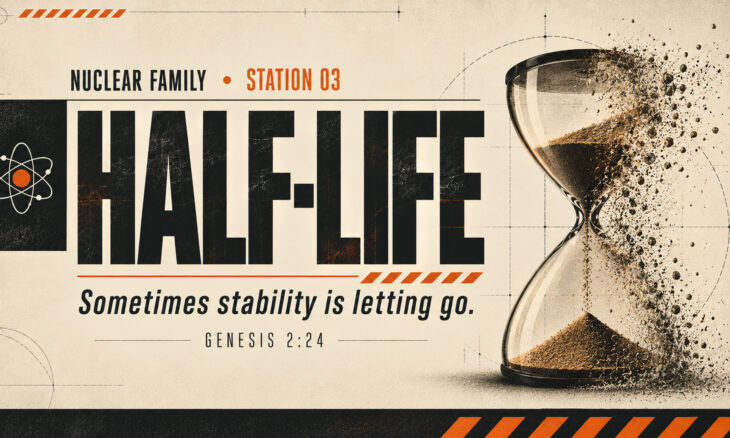
In scientific terms, the half-life is the rate of decay. The measure of how long something takes to fall apart when nothing is holding it together.
That’s what I want to spend our time on this morning. Because most marriages that end don’t blow up. They quietly corrode.
I. WHAT GOD JOINED — Genesis 2:24
Therefore a man shall leave his father and his mother and hold fast to his wife, and they shall become one flesh.
A: Leave
Azab in the Hebrew — to leave, forsake, relinquish, let go.
This is not primarily about distance. It is about dependence and allegiance.
- Couples can move a thousand miles away and never really leave.
- Others can live four doors down from their parents and have completely established a new household.
To “leave” means that something fundamental has changed:
The family you came from is no longer the family around which your life is organized. You are creating a new one.
Before marriage, your parents and family of origin naturally occupy a central place in your life. But marriage creates a new covenant relationship.
Your spouse becomes your primary human loyalty.
- That does not mean you stop loving your parents.
It does not mean you stop honoring them.
It does not mean you stop listening to their wisdom.
It means they no longer have the final voice in your marriage.
I might phrase it this way:
Leaving is not abandoning your family; it is changing which family comes first.
Sometimes we have to leave more than a house.
We may have to leave:
- our family’s way of doing things — “Well, this is how my mother always did it.”
- our family’s expectations — what career we should have, where we should live, how holidays must work.
- our family’s conflicts — refusing to make our spouse inherit battles that existed before they arrived.
- our dependence — constantly running back to Mom or Dad for emotional validation, financial rescue, or marital arbitration.
- our old identity — continuing to think primarily as me rather than learning to think as us.
There is a difference between honoring your parents and remaining governed by your parents.
And perhaps the strongest way to frame the point is:
You cannot become one with your spouse while remaining emotionally attached to your old life as though nothing has changed.
Genesis gives an order:
Leave → Cleave → Become one.
There is a reason leave comes first.
You cannot fully hold fast to something new while refusing to loosen your grip on what came before.
Leaving establishes the priority of the marriage. Holding fast protects that priority. Becoming one is what that covenant gradually produces.
B: Hold fast
Dabaq in the Hebrew — to cling, stick to, hold tightly, remain attached.
The image is almost adhesive.
To hold fast is to cling so closely that separation would mean tearing something that has been joined together.
Genesis does not describe marriage merely as two people who feel strongly about one another.
- It describes two people who attach themselves to one another.
- The same verb appears in Deuteronomy 10:20, where Israel is told:
- “You shall fear the LORD your God. You shall serve him and hold fast to him…”
This is covenant language.
- Not merely affection.
- Not chemistry.
- Not compatibility.
Attachment. Allegiance. Commitment.
Not a feeling. A grip. – Feelings matter enormously in marriage. But feelings fluctuate.
- There will be days when affection comes easily.
- There will be days when you feel close.
- There will also be days when you are exhausted, disappointed, irritated, wounded, or simply disconnected.
Note that Genesis doesn’t say:
- Feel close to your wife.
- It says:
- Hold fast to your wife.
The strength of a marriage is not measured only by how tightly you hold one another when everything is good, but by whether you keep holding when life begins pulling you appart.
Because life will pull.
- Children pull.
- Careers pull.
- Financial pressure pulls.
- Sickness pulls.
- Disappointment pulls.
- Aging parents pull.
- Different schedules pull.
- Unmet expectations pull.
- And sometimes the two people themselves pull against each other.
The biblical answer is not, “Nothing will ever pull you apart.”
When it pulls—hold fast.
Holding fast is more than staying married.
You can remain married while systematically letting go of one another.
- You stop talking.
- Stop touching.
- Stop laughing.
- Stop sharing.
- Stop apologizing.
- Stop asking questions.
- Stop being curious about the person you married.
And eventually the marriage remains intact on paper while the relationship becomes increasingly detached.
You can remain in the same house and still let go of each other.
C: One flesh
“…and they shall become one flesh.” — Genesis 2:24
Oneness is the nature of the covenant God creates.
That is exactly how Jesus speaks about this passage in Matthew 19:6:
“So they are no longer two but one flesh. What therefore God has joined together, let not man separate.”
Notice who Jesus says does the joining.
God does.
- The bride and groom make vows.
- The preacher says words.
- The government files paperwork.
- The couple builds a home.
But Jesus looks behind all of that and says:
God joined them.
- There was him.
- There was her.
- And now there is an us.
One flesh does not mean half a person.
Sometimes we talk about marriage as though each person brings half:
- “You’re my other half.”
- It’s romantic language, but Genesis actually gives us something richer.
God doesn’t take two half-people and create one whole person.
He takes two lives and joins them into one shared life.
- You do not cease to be yourself.
- Your personality doesn’t disappear.
- Your gifts don’t disappear.
- Your calling doesn’t disappear.
But from this point forward, your life can no longer be lived as though the other person were merely an accessory to it.
What affects you now touches us.
This may be one of the most practical implications of the phrase.
If we are one flesh, then there are very few things in marriage that are truly “just my problem.”
- My debt affects us.
- My career choices affect us.
- My habits affect us.
- My sexuality affects us.
- My anger affects us.
- My health affects us.
- My wounds affect us.
- My dreams affect us.
- And my pain can no longer simply be my pain.
If something wounds the person to whom I have been joined, it has entered our life.
Paul picks up precisely this logic in
Ephesians 5:28:
“He who loves his wife loves himself.”
Genesis has changed the math. – You are one flesh.
When I build you up, I strengthen us.
When I tear you down, I damage something I am part of.
II. FAULT LINE – Genesis 3:8–13
One chapter later, the first marriage has its first hard conversation, and watch what it turns into.
God asks Adam a direct question, and Adam answers: the woman whom you gave to be with me, she gave me fruit of the tree, and I ate.
Read that sentence slowly. He blames his wife, and in the same breath he blames God for giving her to him.
- The first recorded defensive sentence in human history is a husband putting his wife between himself and the consequence.
- And Eve does the same thing one verse later.
Neither of them lies. Both of them are technically accurate. And the marriage still cracks.
What happens to what God has joined over time?
“What God has joined together…”
But then He immediately adds:
“…let not man separate.”
Why give the warning?
The greatest danger to many marriages is not an explosion. It is slow decay.
- A little less conversation.
- A little less affection.
- A little less curiosity.
- A little less forgiveness.
- A little more resentment
- A little more separate.
Until something God joined as one begins functioning as though it were two.
It’s what I call “relationship rust”: destructive attitudes working unnoticed until the relationship is put under load.
God did not join you so that either of you would live at half.
Ephesians 4:29 Do not let any unwholesome talk come out of your mouths, but only what is helpful for building others up according to their needs, that it may benefit those who listen.
III. THE DECAY
Put a tool up without cleaning, and don’t look at it for a while; you’re likely to be very disappointed when you go to use it again.
- The rust works in the dark, in the seasons when nobody is looking, and the metal gives way the first time you actually need it to hold.
- It did not fail the day it broke.
- It failed the day you put it up wet.
Paul names the mechanism exactly.
Ephesians 4:29 — let no corrupting talk come out of your mouths, but only such as is good for building up, that it may give grace to those who hear.
The Greek behind corrupting is the ordinary word for rotten fruit and spoiled fish.
- Paul is not talking about profanity. He is talking about speech that is decomposing — and decay spreads to whatever it touches.
Researchers watched couples for four decades and found four behaviors that showed up over and over in the marriages that later ended. They named them after the horsemen in Revelation 6, and the presence of these four alone sorted couples correctly better than eight times out of ten.
Not one of the four is dramatic. Every one of them is something we all experience and struggle with, but should also recognize the danger of.
A: Criticism.
- Criticism is when you stop addressing a behavior and start indicting a character. You forgotbecomes you’re the kind of person who forgets.
- One is a complaint, and complaints are fine — Scripture is full of people complaining to God and to each other. The other is a verdict, and no one can repent of a verdict.
Proverbs 12:18
There is one whose rash words are like sword thrusts, but the tongue of the wise brings healing.
Both of those are aimed at a person. Only one leaves them able to move.
B: Contempt.
Of the four, this one predicts the end more reliably than any other.
- It is the eye roll, the mockery,
- The sarcasm,
- That particular laugh.
- It is criticism that has curdled into disgust.
Contempt says one thing underneath everything else it says: I am above you.
Jesus put this on the table in the Sermon on the Mount.
Matthew 5:22
But I say to you that everyone who is angry with his brother will be liable to judgment; whoever insults his brother will be liable to the council; and whoever says, ‘You fool!’ will be liable to the hell[c] of fire.
Philippians 2:5–8 – is the exact inversion of it.
Have this mind among yourselves, which is yours in Christ Jesus, 6 who, though he was in the form of God, did not count equality with God a thing to be grasped, 7 but emptied himself, by taking the form of a servant, being born in the likeness of men. 8 And being found in human form, he humbled himself by becoming obedient to the point of death, even death on a cross.
The One with every right to say I am above you emptied Himself and took the form of a servant.
Contempt is not just corrosive. It is anti-gospel, in posture and in direction.
C: Defensiveness.
Defensiveness answers a complaint with a counter-complaint, or with the innocent-victim posture.
- It feels like protecting yourself and it lands as reversing the blame.
- Remember Adams response: The woman whom you gave to be with me.Adam invented it and we’ve all been using it since.
- This is the hardest of the four to put down, because giving it up means conceding part of a point you believe you are right about.
D: Shutting down.
The lights go off and nobody signals that anyone is home.
No response, no expression, no acknowledgment that a person just spoke in the room.
Usually it is not indifference.
- It is a person underwater — flooded, overwhelmed, out of capacity.
- Which matters, because the spouse on the other side almost always reads it as contempt, and it almost never is.
Psalm 32:3 — when I kept silent, my bones wasted away. Silence has a cost on both ends of it.
You can live eighteen inches from somebody and run the entire relationship through contempt. People do it in the same bed, for years, and nobody outside the house ever suspects.
That’s half of a life.
God did not join you so that either of you would live at half.
Contempt says:
I win by making you smaller.
But in a one-flesh marriage, if I make you smaller, I have diminished us.
Defensiveness says:
I have to protect myself from you.
But covenant asks:
How do we protect what exists between us?
IV THE REPAIR — Ephesians 4:31–32
When researchers added one more factor to the four- whether a couple made repair attempts, and whether those attempts landed- it altered the outcome significantly.
The four horsemen were never the whole story.
- Every marriage has them.
- What separated the couples who made it was not the absence of damage. It was the presence of repair.
- This should sound familiar, because it is the shape of the whole Biblical story.
Go back to the garden one more time.
- After the blaming, after the hiding, the first voice in that broken relationship is God’s, and it is not a verdict. Genesis 3:9— where are you?
- He knew. He asked anyway.
- That is a repair attempt, offered by the only party in the conversation who had not done anything wrong.
Ephesians 4:31–32 — put away bitterness and wrath and anger and clamor and slander, forgiving one another, as God in Christ forgave you.
So a repair attempt made in your kitchen is a small echo of the one made in the garden and finished at the cross. You do not initiate it because they deserve it. You initiate it because somebody once did that for you.
APPLICATION
- Run the tally on yourself.One week, index card or phone, and mark which of the four you reach for under pressure. Do not write down theirs. The temptation in a sermon like this is to take notes on behalf of your spouse, and that temptation is itself one of the four.
- Trade the verdict for the complaint.I feel ___ about ___. I need ___. It sounds mechanical the first three times you use it and then it stops sounding like anything at all.
- Learn four words: you’re right about that part.Most of us have never said them in an argument we thought we were winning. Concede the percentage you actually owe.
- Name the flood out loud.I’m flooded. Twenty minutes, then I’m back. Shutting down without saying that reads as contempt. Saying it turns a wall into a door with a time on it.
- One specific appreciation, out loud, every day.Not you’re a good mom — the way you handled that phone call this afternoon was patient in a way I’m not. Contempt has the slowest antidote of the four, because fondness rebuilds over months and only rebuilds out loud.
CONCLUSION
What does God join? Two whole lives. Not two fragments.
What is quietly taking it apart? Often four simple habits that entered in a garden and have never left, working in the dark, in the seasons when nobody is looking.
God did not join you so that either of you would live at half. He gave everything so that neither of you would have to.